
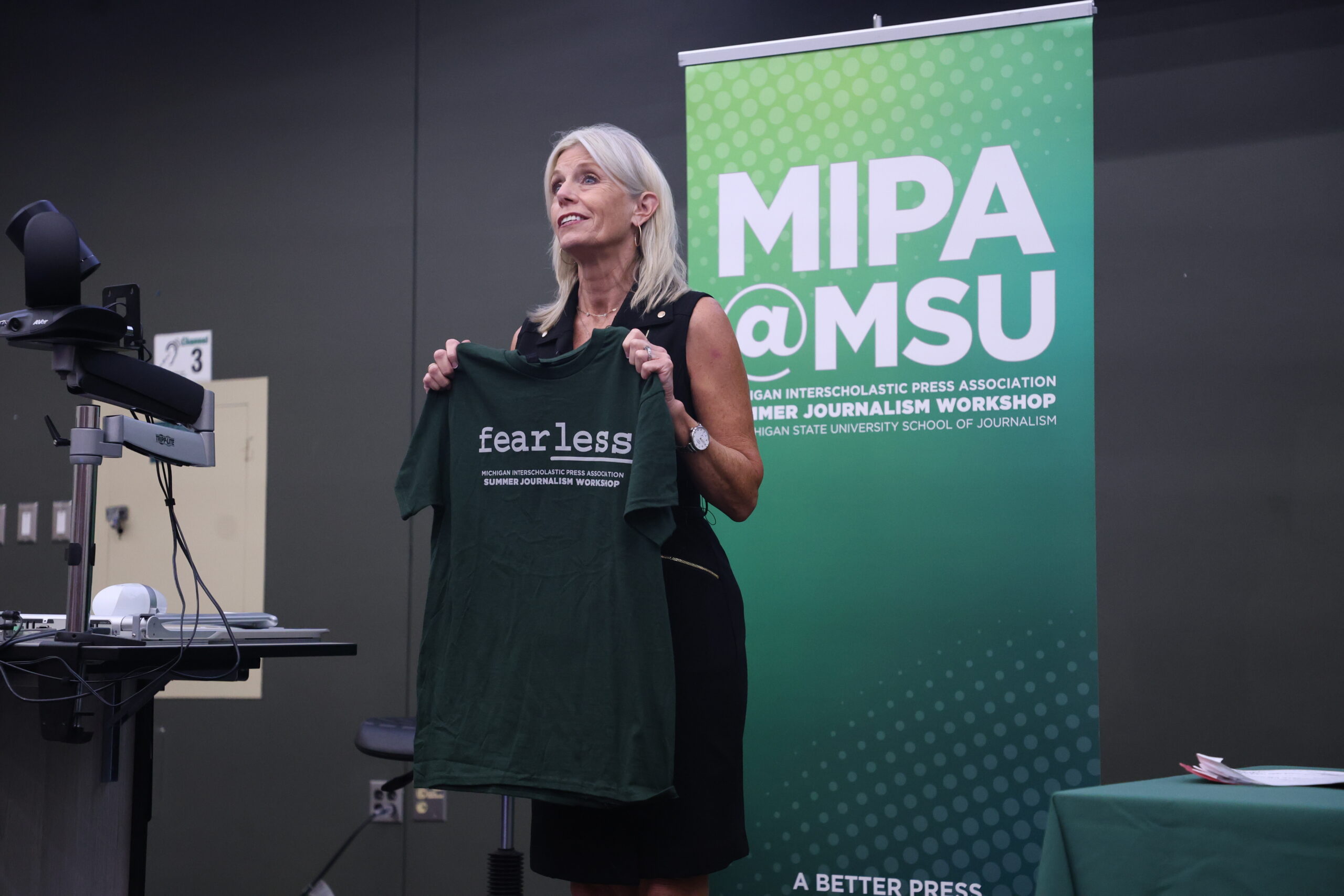
Jumping into her speech as the keynote speaker at the MIPA Summer Journalism Workshop on July 19, retired crime reporter Sheri Jones shares insights on being fearless as a journalist. Jones was a highly awarded broadcaster for WLNS TV6 for 37 years. (Photo by Belle Potter)
Packed pencil to pencil, knee to knee, MIPA students entered N100 on July 19 armed with their first assignments from their respective classes. They were there to do one thing: write the first draft of history.
37 years ago, Sheri Jones was in the seat of many MIPA campers’, before going on to pursue her career as a successful crime reporter.
“You are in the present moment,” Jones said. “You are truth seekers. You are fact writers. You are storytellers based in fact and ethics.”
During her time as a journalist, Jones served as a news anchor for WLNS TV6, gravitating toward crime reporting. In the 1990s, she became most known for her Crime Stoppers segment as the primary spokesperson for the program. According to a City Pulse article, her reports had an 80 percent success rate of removing fugitives from the streets of Michigan in 2018. Jones’ work at WLNS landed her a spot in the Michigan Journalism Hall of Fame, Michigan Association of Broadcasters Hall of Fame and National Academy of Television Arts and Sciences Silver Circle.
“Think about what interests you,” Jones said. “Use the journalism floor to bring [what interests you] into what fuels you.”
Sometimes being the best storyteller doesn’t mean being the fastest reporter, it’s about being fearless. In pursuing the truth and learning how to balance her emotions, Jones imparted her knowledge to MIPA campers about how to bring compassion into journalistic spaces.
“I always wanted to feel,” Jones said. “I didn’t want to become so callous that I wasn’t affected by stories.”
Sometimes, that simply meant sitting down at her desk, putting her head in her hands and letting herself cry. 15 minutes later, Jones would be on air, telling a story that had destroyed her just moments before.
“When I was on television, I would present [the story] in an empathetic way and make sure that people knew that I was sincere in that,” Jones said. “I [had to make] sure that I protected my empathy.”
The difficult stories didn’t scare her away—instead, she bottled that fear and used it to fuel her storytelling. Jones encourages the young journalists at MIPA to do the same.
“Ask one more question,” Jones said. “You have to be bold. You have to be brave. You have to be courageous. Integrity is courage and sometimes no one applauds that in the moment, but it definitely does define your career.”