
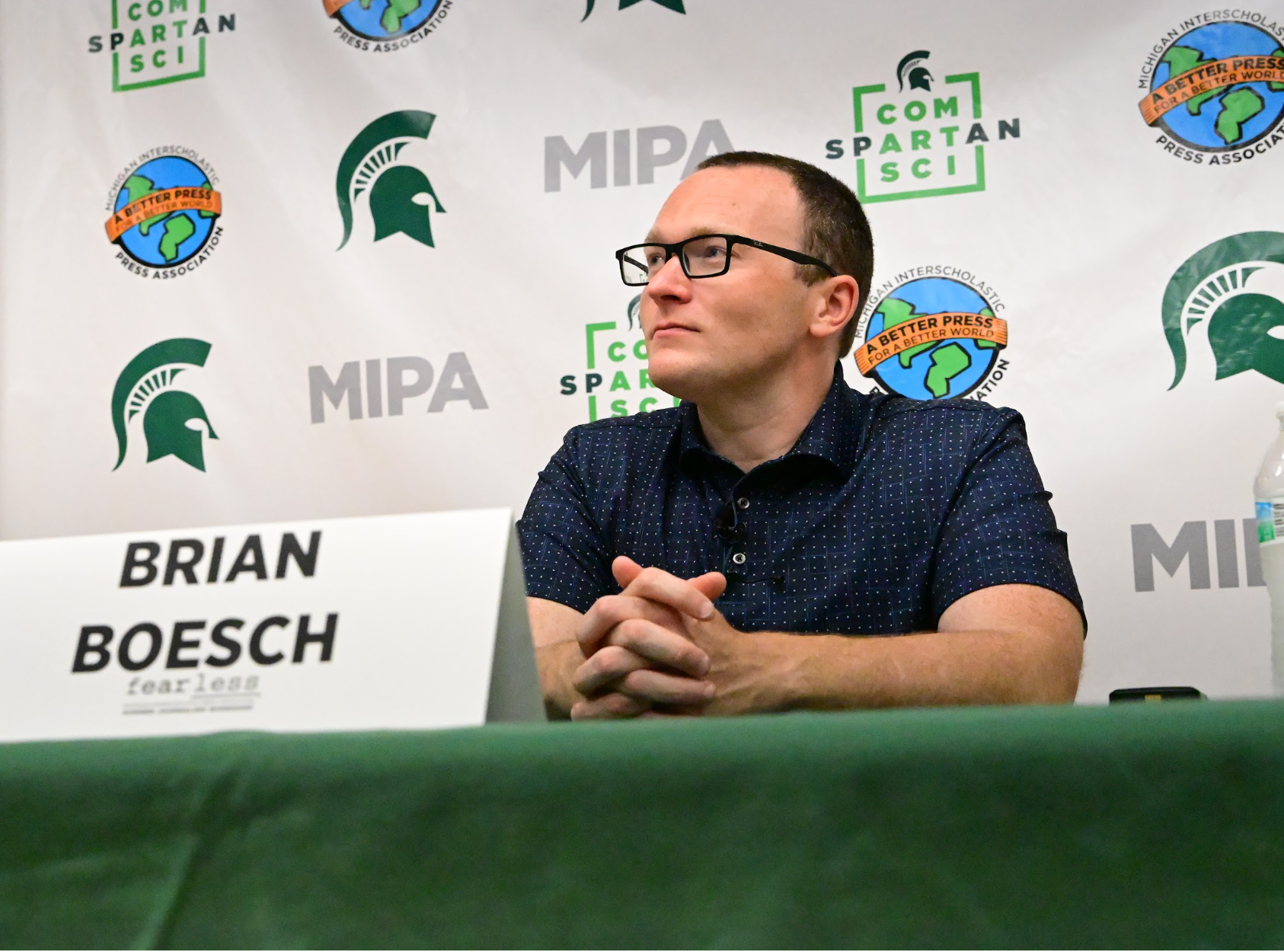
Sports journalist Brian Boesch speaks to MIPA campers at a Monday night press conference. (Photo by David Pavelich)
Brian Boesch is a passionate sports journalist. Currently a broadcaster for the University of Michigan, Boesch was pushed by his father to explore journalism as a middle schooler.
“I was in eighth grade, and I had the option to take second study hall, and eighth grade Brian’s like ‘heck yeah’,” he said. “But my dad said, ‘Hey, there’s a few electives left this year; try one,’ and I picked journalism.”
In his teens, he went to a camp similar to MIPA at Ohio University. That camp planted a seed, and with his passion for sports and writing, that seed was nurtured into an expansive, successful career.
“I did not have the social confidence or willingness to jump into a lot of different things,” Boesch said. “But that was the first time I saw a potential future for [myself] in this industry.”
Boesch has been in the field professionally for fourteen years, and in that time, he has learned lessons that are invaluable to anyone aspiring for a job in it. He recounted a story of his early work in which he made a bad call at the second half of a game due to applying for an award (that he later won) during halftime.
“Even though I was named one of the top forecasters in college, I could not stop thinking about how bad that all was,” he said. “For me, it was instructive because it showed me that you are only as good as your next sequence, your next pitch, your next shot. It’s a very ‘what have you done for me lately’ type of thing.”
Along with this, Boesch highlights the idea that journalism is a line of work that is entirely dependent on people–people to know, people to speak to, people to work with, etc. Boesch’s work ethic is one rooted in a fundamental understanding of this dependency. More so, Boesch emphasises the importance of connections, as well as the distinction between knowing people and people knowing you.
“[Networking] is easy to do in the first round. There’s a lot of people older than me that invested in me, and I like reciprocating,” he said. “But after that first conversation, how do you keep that relationship going? Who will be excited to have that phone call or email? That is so crucial.”
When it comes to his work itself, Boesch is a swiss army knife of skill. He asserts that in the current landscape of journalism, one cannot be versed in only one area.
“The example on my side is that yes, me being in broadcast got me the job. But they had trusted me because I was hosting a podcast, because I enacted sponsorships as well, because I work well with people and because I can write,” he said. “I can’t just be a good broadcaster and have a job in the industry.”
As well as this, he emphasized the fact that he is not an impartial journalist, especially in the age of AI.
“I think now there’s so many ways to come by information,” he said, “that now it’s important for us to distill and understand what the motivations or desires of that information are.”
Ultimately, what has fueled Boesch’s profession is his passion. It is something that was instilled within him from watching sports, from seeing journalists like Tom Hamilton do work that inspired him. His desire for this career was something that existed before he was able to identify it for himself.
“I always wanted to [work in sports] and a professor at college saw something in me even before I saw it in myself,” he said. “I don’t know if it was ever a eureka moment for me, I think it stacked on top of each other until it became what I did and what I was passionate about.”
Boesch’s lessons in journalism show that everything you need to be successful in this field are skills that can be fostered–you just need to have the passion to go for it. The seeds that you plant matter.